

How do modern latent variable models like invertible models (normalizing flows) balance between expressiveness and tractability in generative modeling?
Modern latent variable models, such as invertible models or normalizing flows, are instrumental in the landscape of generative modeling due to their unique ability to balance expressiveness and tractability. This balance is achieved through a combination of mathematical rigor and innovative architectural design, which allows for the precise modeling of complex data distributions while maintaining computational feasibility.
Expressiveness in Normalizing Flows
Expressiveness in the context of generative models refers to the model's ability to capture and represent complex data distributions. Normalizing flows achieve high expressiveness through a series of invertible transformations. These transformations map a simple base distribution, such as a multivariate Gaussian, to a more complex target distribution that resembles the data distribution.
The core idea behind normalizing flows is that a complex distribution can be obtained by applying a sequence of invertible and differentiable functions to a simple initial distribution. Mathematically, if  is a latent variable drawn from a simple distribution
  , and
, and  is the observed variable, the relationship between and can be expressed through a series of transformations
  :
:
![\[ x = f_K \circ f_{K-1} \circ \cdots \circ f_1(z). \]](https://eitca.org/wp-content/ql-cache/quicklatex.com-5a2dde6531b5cbfd8f90ee52107dcf4e_l3.png "Rendered by QuickLaTeX.com")
The sequence of transformations is designed to be invertible, ensuring that each transformation has a well-defined inverse. This invertibility is important for both sampling and likelihood estimation.
Tractability in Normalizing Flows
Tractability, on the other hand, involves the ability to efficiently compute the likelihood of observed data and to sample from the model. Normalizing flows ensure tractability by leveraging the change of variables formula in probability theory, which allows for the computation of the probability density function of the transformed variable. Given the invertible transformation  , the density of can be computed as:
![\[ p_X(x) = p_Z(z) \left| \det \left( \frac{\partial f^{-1}(x)}{\partial x} \right) \right|, \]](https://eitca.org/wp-content/ql-cache/quicklatex.com-2a84c5ba5dd78467ffeb8632b293cfb6_l3.png "Rendered by QuickLaTeX.com")
where 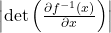 is the absolute value of the determinant of the Jacobian matrix of the inverse transformation
  .
.
For the model to be tractable, the Jacobian determinant must be efficiently computable. This requirement influences the design of the invertible transformations used in normalizing flows. Popular choices include affine coupling layers and autoregressive transformations, which are specifically designed to allow for efficient computation of the Jacobian determinant.
Affine Coupling Layers
Affine coupling layers are a common building block in normalizing flows. In an affine coupling layer, the input variable is split into two parts:  and
and  . The transformation is then defined as:
![\[ y_1 = x_1, \]](https://eitca.org/wp-content/ql-cache/quicklatex.com-539936a2d0799a9965c2cf944a108847_l3.png "Rendered by QuickLaTeX.com")
![\[ y_2 = x_2 \odot \exp(s(x_1)) + t(x_1), \]](https://eitca.org/wp-content/ql-cache/quicklatex.com-f311ad6818317ffc3686fc140b39446c_l3.png "Rendered by QuickLaTeX.com")
where  and
and  are scale and translation functions, respectively, and
  denotes element-wise multiplication. The inverse transformation is straightforward:
![\[ x_1 = y_1, \]](https://eitca.org/wp-content/ql-cache/quicklatex.com-d346e78d051cea879a939999d9879b73_l3.png "Rendered by QuickLaTeX.com")
![\[ x_2 = (y_2 - t(y_1)) \odot \exp(-s(y_1)). \]](https://eitca.org/wp-content/ql-cache/quicklatex.com-86573661140860d5055122ab5d6336c6_l3.png "Rendered by QuickLaTeX.com")
The Jacobian of this transformation is triangular, making its determinant easy to compute as the product of the diagonal elements:
![\[ \det \left( \frac{\partial (y_1, y_2)}{\partial (x_1, x_2)} \right) = \exp \left( \sum_i s_i(x_1) \right). \]](https://eitca.org/wp-content/ql-cache/quicklatex.com-ce5bc822092e859a7bae49b46f97ed05_l3.png "Rendered by QuickLaTeX.com")
This design ensures that the transformation is both expressive and tractable.
Autoregressive Transformations
Autoregressive transformations are another key component in normalizing flows. In an autoregressive model, the transformation of each variable depends on the previous variables in a sequential manner. For example, in a masked autoregressive flow (MAF), the transformation is defined as:
![\[ y_i = \mu_i(x_{<i}) + \sigma_i(x_{<i}) \cdot x_i, \]](https://eitca.org/wp-content/ql-cache/quicklatex.com-bc5ce0fc909cc265769947767bf31718_l3.png "Rendered by QuickLaTeX.com")
where  and
and  are functions of the preceding variables
  . The inverse transformation is similarly defined, and the Jacobian determinant is the product of the diagonal elements:
![\[ \det \left( \frac{\partial y}{\partial x} \right) = \prod_i \sigma_i(x_{<i}). \]](https://eitca.org/wp-content/ql-cache/quicklatex.com-c85eaf1e8f03150c548cfa13e023f200_l3.png "Rendered by QuickLaTeX.com")
Autoregressive transformations are highly expressive because they allow for complex dependencies between variables, and they are tractable because the Jacobian determinant is easy to compute.
Practical Applications and Examples
Normalizing flows have been successfully applied in various domains, including image generation, density estimation, and anomaly detection. One notable example is the Glow model, which uses a series of invertible 1×1 convolutions and affine coupling layers to generate high-quality images. Glow demonstrates the power of normalizing flows in capturing the intricate details of natural images while maintaining tractability for both sampling and likelihood estimation.
Another example is the RealNVP model, which also uses affine coupling layers and has been applied to tasks such as image generation and density estimation. RealNVP's design ensures that the model is both expressive and computationally efficient, making it a popular choice for generative modeling.
Conclusion
Modern latent variable models like normalizing flows achieve a delicate balance between expressiveness and tractability through the use of invertible transformations and efficient computation of the Jacobian determinant. By leveraging affine coupling layers and autoregressive transformations, these models can capture complex data distributions while ensuring that likelihood estimation and sampling remain computationally feasible. The success of models like Glow and RealNVP in various applications highlights the effectiveness of normalizing flows in generative modeling.
Other recent questions and answers regarding Examination review:
- What are the primary advantages and limitations of using Generative Adversarial Networks (GANs) compared to other generative models?
- What is the reparameterization trick, and why is it crucial for the training of Variational Autoencoders (VAEs)?
- How does variational inference facilitate the training of intractable models, and what are the main challenges associated with it?
- What are the key differences between autoregressive models, latent variable models, and implicit models like GANs in the context of generative modeling?